



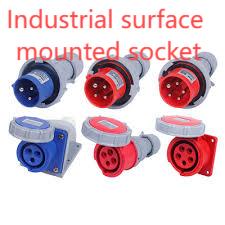
In heavy-industry environments, specifying the right Industrial Plug Socket Connector early prevents costly mismatches during commissioning, and operators depend on a Industrial Plug Socket Connector that balances electrical performance with robust sealing and straightforward maintenance. This article explains how to specify, install, and maintain industrial connectors for reliable service: mechanical design, contact performance, sealing strategies, installation accessories, and a practical maintenance plan tailored for demanding sites.
Mechanical Design and Site-Ready Housings
Mechanical durability begins with the housing. Choose materials that suit the local environment: die-cast aluminum provides impact resistance and heat dissipation, stainless steel offers superior corrosion resistance for coastal or chemical sites, and reinforced thermoplastics can be ideal where weight matters. Look for recessed mating faces and protective bezels to guard contacts from direct impact. Locking systems (threaded collars, bayonets, or positive latch mechanisms) should resist vibration and provide tactile confirmation of secure mating. Also, consider IK impact and IP ingress ratings together — a rugged face with poor sealing is still a frequent cause of field failure.
Contact Technology and Electrical Performance
Reliable electrical performance depends on contact metallurgy, geometry, and spring systems. Copper alloys with silver or nickel plating combine conductivity with wear resistance; multi-finger or split contacts increase contact area and reduce localized heating. Spring-loaded contacts maintain consistent pressure through many mate/demate cycles, lowering contact resistance and preventing thermal runaway at high currents. Review derating curves for elevated ambient temperatures and enclosure conditions, and always match connector ampacity to expected continuous and inrush loads to avoid premature overheating.
Sealing Strategies and Environmental Protection
Ingress protection requires more than a single gasket — it’s about door geometry, gland selection, and accessory compatibility. O-rings, molded gaskets, and tongue-and-groove doors each have trade-offs in longevity and serviceability. In washdown or outdoor locations, specify hydrophobic vent membranes or pressure-equalizing vents to avoid seal extrusion and internal condensation while preventing liquid ingress. Confirm that dust caps, gland plates, and weather hoods are part of the rated configuration — accessories are frequently the weak link that reduces the overall protection level.
Nante Integration and Accessory Strategy
Using factory-approved accessory kits simplifies installation and preserves ratings. Nante offers matched gland plates, dust caps, locking collars, and mounting frames that adapt a connector family to panel, pole, or pendant configurations without compromising IP/IK performance. Standardized accessory families reduce spare-part diversity and shorten repair times. For installations requiring quick turnaround, pre-wired harnesses and dry-fit templates save significant on-site labor while minimizing wiring errors during final commissioning.
Installation Best Practices and Wiring Discipline
Proper installation preserves long-term reliability. Follow torque specifications for captive fasteners to ensure repeatable seal compression; oversized or undersized torque values are common causes of premature seal failure. Use correctly sized cable glands and strain relief to eliminate conductor movement at terminations. Maintain clear separation between power, control, and communication cables to reduce interference and simplify diagnostics. Label phases and include as-built wiring diagrams inside the enclosure so future technicians have immediate reference during maintenance.
Thermal Management and Monitoring Options
Heat is an insidious cause of connector failures. In compact or enclosed installations, provide airflow paths or filtered ventilation to maintain contact temperatures within rated limits. Reflective finishes or shaded mounting reduce solar gain for outdoor housings. Consider adding simple monitoring—temperature probes at critical terminations or fused-channel current sensors—to detect marginal connections early and move maintenance from reactive to proactive.
Maintenance Routines and Spare-Part Planning
A predictable maintenance cadence reduces unplanned outages. Schedule periodic torque checks, visual gasket inspections, and thermal imaging during planned outages to spot hot terminations. Keep a prioritized spare kit—replacement gaskets, dust caps, and common contact inserts—on site to shorten repair times. Document baseline thermal and electrical measurements during commissioning for later comparison; these records accelerate root-cause analysis when excursions occur.
Retrofit Strategies and Lifecycle Thinking
When upgrading legacy systems, preserved conduit paths and reusable harnesses accelerate deployment, but always evaluate earthing and bonding quality—new connectors cannot compensate for poor grounding. Modular connector families with replaceable inserts enable partial repairs rather than full-unit replacements, lowering lifecycle cost and shortening downtime. Factor accessory lead times and regional spare availability into procurement decisions to avoid long waits during critical repairs.
Safety, Standards, and Documentation
Confirm compliance with relevant standards (IEC, UL, or local equivalents) and obtain third-party test reports for dielectric strength, short-circuit withstand, and ingress ratings where required by the project. Provide clear lockout/tagout access and include mate/demate instructions for operators. Maintain an as-built dossier with torque values, part numbers, and spare-part lists to support future maintenance and audits.
Choosing the right connector family is a systems decision that balances contact metallurgy, mechanical protection, sealing, accessories, and maintenance capability. Thoughtful specification and disciplined commissioning reduce risk, improve uptime, and lower total cost of ownership. For technical data, accessory lists, and detailed application guidance, visit https://www.nante.com/news/industry-news/what-is-industrial-plug.html