


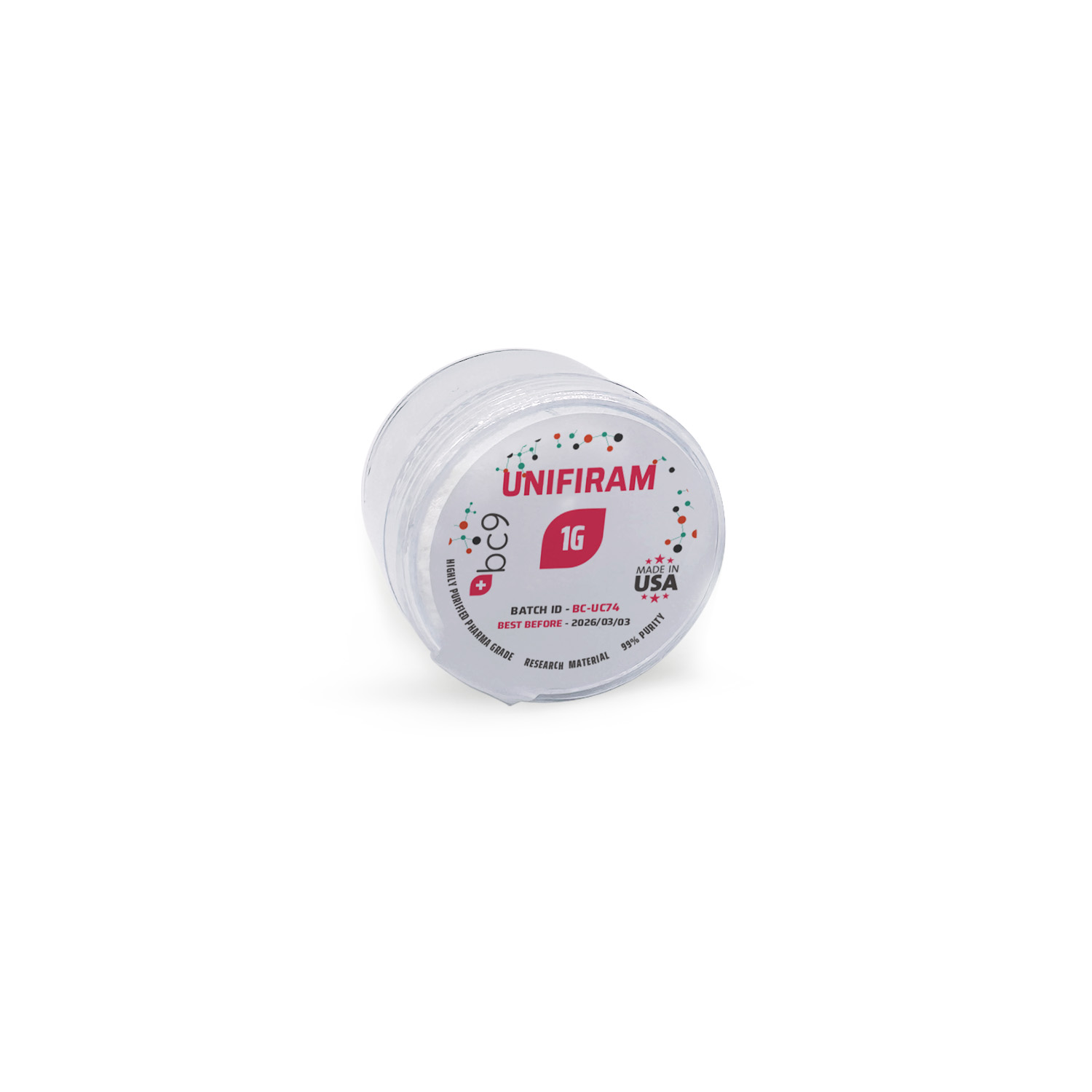
Unifiram is a synthetic ampakine-related compound investigated for its interaction with glutamatergic signaling and downstream cognitive processes. Distinguished by its high potency at extremely low concentrations, Unifiram has become a focal point in advanced nootropics research, particularly in studies examining synaptic efficiency, memory encoding, and neuroplastic signaling. Within laboratory contexts, unifiram powder nootropics are explored exclusively as research materials to evaluate molecular interactions rather than consumer applications.
Chemical Classification and Structural Considerations
Unifiram belongs to a class of low-molecular-weight heterocyclic compounds structurally related to the racetam family, though its pharmacological profile diverges significantly. The molecule’s conformational flexibility allows for rapid interaction with ionotropic glutamate receptors, particularly AMPA receptor complexes.
Key structural characteristics relevant to research:
- Small molecular mass enabling rapid blood–brain barrier penetration in model systems
- Absence of chiral centers, simplifying receptor-binding simulations
- High affinity signaling at sub-milligram laboratory concentrations
These properties make Unifiram a useful reference compound in comparative studies of synaptic modulation.
Mechanistic Focus: Interaction With Glutamatergic Pathways
Unifiram is primarily studied for its indirect modulation of AMPA receptor-mediated neurotransmission. Rather than acting as a direct agonist, research indicates facilitation of receptor responsiveness, increasing excitatory post-synaptic potential efficiency.
Key Mechanistic Observations
- Enhancement of AMPA receptor throughput without sustained depolarization
- Secondary influence on NMDA receptor signaling through synaptic cross-talk
- Modulation of intracellular calcium dynamics linked to learning pathways
This mechanistic profile positions Unifiram as a valuable probe in studies exploring long-term potentiation (LTP).
Cognitive Pathway Mapping in Research Models
Laboratory investigations frequently examine Unifiram’s role in higher-order cognitive signaling cascades. These pathways are central to memory formation, associative learning, and executive processing in controlled environments.
Comparison With Other Advanced Nootropics
In analytical comparisons, Unifiram is often evaluated alongside compounds such as Aniracetam, Sunifiram, and CX-series ampakines. Unlike classical racetams, Unifiram exhibits activity at substantially lower concentrations, making it a benchmark compound for potency-focused studies.
|
Compound |
Primary Mechanism |
Relative Potency |
Research Focus |
|
Unifiram |
AMPA modulation |
Very High |
Synaptic efficiency |
|
Aniracetam |
AMPA modulation |
Moderate |
Memory & mood |
|
Sunifiram |
AMPA/NMDA |
High |
Learning models |
|
CX-717 |
Ampakine |
Moderate |
Cognitive endurance |
This differentiation highlights why unifiram powder nootropics are used in precision-driven experimental setups rather than broad-spectrum cognitive research.
Pharmacokinetic Observations in Experimental Contexts
In preclinical research, Unifiram demonstrates rapid absorption and central nervous system availability. Its short half-life in model organisms allows researchers to observe acute cognitive signaling changes without prolonged systemic accumulation.
Notable pharmacokinetic traits:
- Rapid onset in laboratory models
- Short-lived plasma presence
- Clear dose–response curves at micro-scale levels
These characteristics are valuable in time-sensitive neurocognitive experiments.
Safety Profiling and Ethical Research Handling
Within formal research environments, Unifiram is handled under strict laboratory protocols. Toxicological profiling remains limited, reinforcing its designation as a research-only compound. Ethical handling standards emphasize controlled environments, qualified personnel, and documented experimental justification.
Relevance of Unifiram Powder Nootropics in Modern Research
The use of unifiram powder nootropics in analytical laboratories supports advanced investigations into synaptic plasticity and cognitive signaling efficiency. Its exceptional potency and targeted mechanism allow researchers to isolate AMPA-mediated effects with minimal confounding variables, enhancing experimental clarity.
Future Research Directions and Scientific Value
Ongoing interest in Unifiram centers on its role as a molecular tool rather than a therapeutic candidate. Future studies are expected to focus on:
- Detailed receptor-binding kinetics
- Comparative analyses with next-generation ampakines
- Computational modeling of synaptic modulation
As neuroscience continues to refine its understanding of learning and memory at the synaptic level, Unifiram remains a strategically important compound in advanced nootropic research literature.
Concluding Perspective
Unifiram occupies a specialized position within advanced nootropics research due to its precision, potency, and mechanistic specificity. Its continued study contributes valuable insight into glutamatergic signaling, synaptic efficiency, and cognitive pathway optimization in controlled scientific environments.