


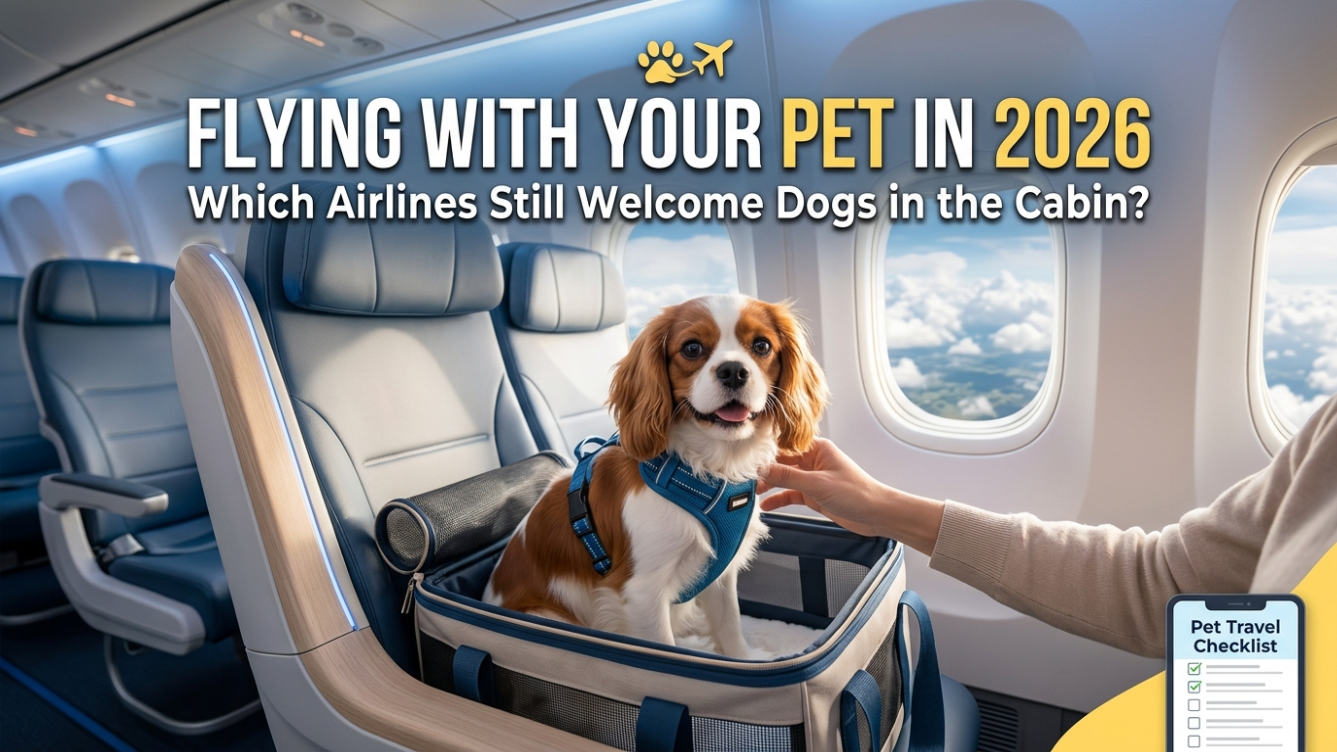
Flying with your dog used to be a simple process: you notified the airline, had the proper paperwork ready, and your companion joined you in the cabin. That changed in January 2021 when the U.S. Department of Transportation updated the Air Carrier Access Act, tightening the rules for air travel with service and emotional support animals. Since then, flying with a dog in the cabin has required more careful planning, and many airlines now have stricter documentation and restrictions in place.
If you have a trip planned in 2026 and want your dog at your feet instead of in cargo or left at home, it’s important to know the current regulations. This guide covers which airlines still allow dogs in the cabin, the documentation required for different situations, and the one route that can still let your dog fly with you at no extra charge. Being informed ahead of time ensures a smoother travel experience for both you and your furry companion.
What the 2021 Rule Change Did, And Why It Still Matters
The DOT's updated rule gave airlines full authority to classify Emotional Support Animals as pets rather than service animals. Most major U.S. carriers stopped accepting ESAs under any special status almost immediately. Dogs that previously flew in the cabin free of charge were reclassified, and pet fees, carrier restrictions, and size limits became the new baseline for anyone traveling with an animal.
Here is how the categories break down today:
|
Animal Type |
Cabin Access |
Fee |
Documentation |
|
Trained Service Dog |
Yes, free |
None |
DOT Service Animal Form |
|
Psychiatric Service Dog (PSD) |
Yes, free |
None |
PSD letter + DOT form |
|
Emotional Support Animal (ESA) |
Treated as pet |
Standard pet fee |
Pet carrier + vaccination records |
|
Regular pet (dog or cat) |
Yes, with fee |
Varies by airline |
Health records, approved carrier |
The gap between a Psychiatric Service Dog and an Emotional Support Animal matters more now than ever. PSDs are task-trained to perform specific actions tied to a handler's mental health condition. That training is what keeps them in the service animal category under federal law and out of the pet fee column.
U.S. Airlines: In-Cabin Dog Policies for 2026
Small dogs can still fly in the cabin on most major U.S. carriers, they just travel as standard pets now, with fees attached and carrier dimensions enforced at the gate. Here is how the major airlines line up:
Domestic Carriers Accepting Small Dogs In-Cabin
- Delta Air Lines, $95 domestic / $200 international. Soft-sided carrier required. Must fit under the seat in front of you. (Delta ESA policy)
- United Airlines, $125 per trip. Dogs, cats, and small household birds accepted. Snub-nosed breeds restricted on select routes. (United ESA policy)
- American Airlines, $150 each way. Dogs and cats only. ESA accommodations no longer apply, pet-only policy is fully in effect. (American Airlines ESA policy)
- Southwest Airlines, $125 per way. Domestic flights only. No pets on Hawaii routes or international itineraries. (Southwest ESA policy)
- JetBlue, $125 per trip. Small dogs and cats allowed in-cabin with an FAA-approved soft-sided carrier. (JetBlue ESA policy)
- Alaska Airlines, $100 each way. Dogs and cats accepted with health records; breed and size restrictions vary by route. (Alaska Airlines ESA policy)
- Spirit Airlines, Fees vary by route. Dogs and cats permitted in-cabin in approved carriers under the seat. (Spirit Airlines policy)
What every carrier above has in common: size limits are firm, carrier dimensions vary by aircraft type, and only trained service dogs avoid the pet fee structure entirely. If your dog cannot fit under the seat in an approved soft carrier, cargo becomes the only domestic option, unless you qualify for a PSD designation.
International Carriers With More Flexible Policies
Several international airlines did not follow the U.S. carriers' lead. If your itinerary includes any of these airlines, current documentation may still make a real difference, though policies shift, and confirming directly with the airline before booking is non-negotiable.
|
Airline |
Policy |
Key Requirement |
Advance Notice |
|
LATAM Airlines |
ESAs accepted on South American & select international routes |
ESA letter issued within 12 months |
48 hours min. |
|
Volaris |
ESAs allowed on Mexico and select international routes |
ESA letter + health certificate within 10 days of travel |
48 hours min. |
|
Aeromexico |
ESAs accepted on domestic and international routes |
ESA letter + vaccination records; dog must be under 33 lbs |
Contact airline |
|
WestJet |
ESAs accepted for verified mental health conditions |
ESA letter + advance coordination with airline |
48 hours min. |
For international travel, the destination country may add another layer, quarantine periods, additional health certificates, or entry restrictions that apply regardless of the airline you choose. Research import requirements for your specific destination well before you book.
The Option That Still Gets Your Dog a Free Seat in the Cabin
If you live with a qualifying mental health condition, PTSD, severe anxiety, panic disorder, major depression, and your dog is trained to perform specific tasks directly connected to that condition, the PSD designation changes your entire travel situation.
What a valid PSD designation provides under the ACAA:
- Your dog travels in the cabin at no charge, service animals are not subject to pet fees
- No breed or size restrictions apply to service dogs under federal ACAA rules
- You submit a DOT Service Animal Air Transportation Form, not a pet reservation
- The dog must remain under control and behave appropriately throughout every stage of travel
- The handler must have a documented mental health disability, general comfort alone does not qualify
The task-training requirement is the legal line that separates a PSD from an ESA in the air. Qualifying tasks include interrupting panic attacks, grounding during dissociation episodes, reminding the handler to take medication, and applying pressure therapy during acute anxiety. General comfort and emotional presence do not meet the standard. If you need a proper evaluation, the licensed mental health professionals at RealESALetter.com can assess your situation and help you understand which documentation fits, whether that is an ESA letter for housing or a PSD letter for travel.
Breed Restrictions: What Airlines Do Not Always Advertise
Meeting weight and size requirements is only part of the equation. A number of airlines maintain breed-specific restrictions that are not obvious when you are booking online. These apply to pets traveling under standard pet policies, not to trained service animals, who are generally exempt from breed bans under federal law.
|
Breed Category |
Reason Restricted |
Airlines Most Likely to Apply It |
|
Brachycephalic breeds, Bulldogs, Pugs, Boxers, Boston Terriers |
Respiratory complications at altitude and in pressurized cabins |
Delta, United, American, Alaska |
|
Wolf hybrid breeds |
Classified as behaviorally unpredictable by most carriers |
Most major U.S. carriers |
|
Pit Bull type breeds (traveling as pets) |
Carrier-specific breed ban policies |
Several carriers; varies by route and destination |
|
Large and extra-large breeds |
Cannot fit under the seat in any approved carrier |
All airlines, cargo only, or PSD pathway required |
If you own one of these restricted breeds, understanding your options is critical. A PSD vs ESA comparison can help determine which designation provides the protections you need for air travel.
Emotional Support Animal Letters and Air Travel in 2026
An Emotional Support Animal Letter did not lose all of its relevance when U.S. carriers changed their policies. For travelers flying on international airlines that still honor ESA documentation, a current letter from a licensed mental health professional remains a hard requirement. It also serves as the foundational documentation for a PSD evaluation if your dog is task-trained, and it carries full legal weight for housing under the Fair Housing Act.
Where an ESA letter still matters for travelers in 2026:
- International carriers including LATAM, Volaris, Aeromexico, and WestJet require a current, professionally issued letter for any in-cabin ESA accommodation
- A valid letter documents your mental health need, the starting point for any PSD evaluation if your dog is task-trained
- Hotels and short-term rental accommodations in some international destinations still reference ESA documentation for animal-friendly room requests
- Housing protections under the Fair Housing Act remain fully intact regardless of airline policy changes, your letter still prevents landlords from charging pet fees or denying housing based on your animal
Pre-Flight Checklist: What to Have Ready Before You Board
For Pets Traveling in the Cabin
- Soft-sided carrier within the airline's exact dimension limits, measure before you travel, not after
- Current vaccination records, required for all international routes, recommended for domestic
- Health certificate issued within 10 days of departure for most international travel
- Pet reservation confirmed on your specific booking, per-flight pet capacity is limited
- Pet fee ready at check-in, some carriers require prepayment during online booking
For Psychiatric Service Dogs
- Completed DOT Service Animal Air Transportation Form, required by all major U.S. carriers
- PSD letter from a licensed mental health professional, dated within the past 12 months
- Documentation submitted at least 48 hours before departure on most carriers
- Dog leashed or harnessed and under full control from check-in through arrival
- Clear knowledge of the specific tasks your dog is trained to perform, you may be asked
Six Tips for a Smoother Trip With Your Dog
- Call the airline after booking, do not rely only on the website, Confirm your pet is registered on your reservation and the flight has not hit its per-cabin pet limit. One call prevents most problems on travel day.
- Arrive earlier than you think necessary, Check-in with a dog takes longer. Document reviews, carrier weighing, and gate confirmations all add time. Build in a buffer.
- Walk your dog before heading to the terminal, A well-exercised dog settles faster in a carrier. Thirty minutes of activity before departure makes a measurable difference mid-flight. (Emotional support dog training tips)
- Hold off on feeding before the flight, A full stomach raises the risk of motion sickness. Feed your dog at least four to six hours before departure.
- Put something familiar in the carrier, A worn shirt or familiar toy helps reduce stress in an unfamiliar, noisy environment, and takes up very little space.
- Know your rights if you are traveling with a PSD, If you face questions at the gate, calmly reference the ACAA. Having your documentation accessible and knowing what tasks your dog performs handles the vast majority of situations quickly.
Bottom Line
Flying with a dog in 2026 takes more planning than it once did, but the door is not closed. Small dogs travel in the cabin on nearly every major U.S. carrier as pets, with fees and carrier requirements attached. If your mental health condition is genuine and your dog is task-trained to assist you, the Psychiatric Service Dog pathway remains fully intact under federal law and changes the financial and logistical picture entirely.
Get the right documentation in place before you reach the airport. Verify your airline's current policy directly, not through a third-party summary. And if you are unsure whether an ESA letter or a PSD letter is the right fit for your situation, get a proper evaluation from a licensed professional before you book. The rules are clear, it just takes a few deliberate steps to make sure you are on the right side of them when you board.