

You have studied risk management, governance frameworks and information security program development. You feel like the CISM is coming together. Then a scenario question asks whether a specific situation calls for BCP activation or DRP execution - and both feel like the right answer.
That's not a gap in knowledge. That is a gap in how the concepts connect under exam pressure.
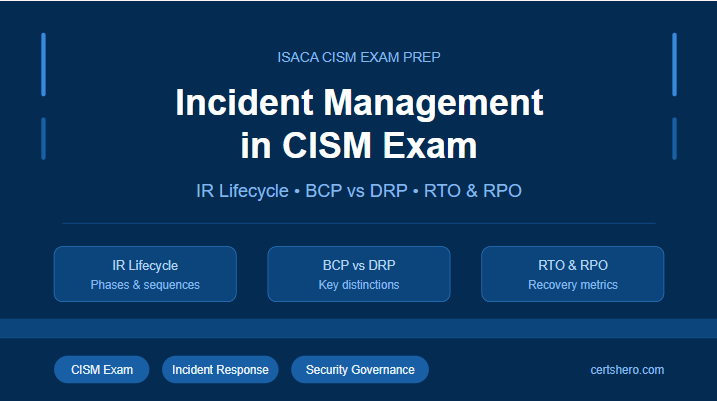
This guide covers IR lifecycle, BCP and DRP at the level the CISM actually tests them.
Why Incident Management Trips Up Experienced Professionals
The CISM isn't an entry-level exam. Most candidates have real-world experience with incidents, business continuity and disaster recovery.
That experience sometimes works against them. Real-world implementations vary - your organization's DRP might overlap with what another company calls BCP. The exam uses precise definitions and those definitions don't always match what you've seen in practice.
Letting go of how your organization does it is sometimes the hardest part of preparing for this exam.
The IR Lifecycle: What the CISM Tests at Each Phase
The CISM doesn't just test phase names - it tests what decisions and actions belong in each one.
Preparation is the foundation. Security policies, IR plans, team roles and tool readiness all belong here. The exam tests this when an incident response fails due to missing documentation or undefined roles.
Detection and analysis is where triage happens. Is this a security event or an actual incident? Misclassifying wastes resources. Missing a real incident causes damage. That judgment call is a direct exam question.
Containment has two layers the exam distinguishes. Short-term containment isolates affected systems quickly. Long-term containment stabilizes the environment before eradication begins.
Eradication removes the root cause. Recovery restores normal operations. The sequence matters - eradication must precede recovery. Reversing these in a scenario answer is a common and costly mistake.
Post-incident review is tested more heavily than most candidates expect. The primary output is documented lessons learned that feed back into preparation. Closing that loop is the entire point.
BCP vs DRP: The Distinction the Exam Relies On
This is the most commonly confused area in the entire incident management domain.
BCP focuses on keeping critical business functions operational during a disruption. The question it answers: how does the organization continue to function when normal operations are interrupted?
DRP focuses on restoring IT systems and infrastructure after a disruption. The question it answers: how do we get systems back online?
BCP is broader. DRP sits inside BCP as a component - not alongside it as an equal.
An organization can activate BCP without activating DRP. Staff move to a backup facility and operate manually while IT systems remain online. DRP without BCP context is just a technical checklist with no business alignment.
A flood destroys a data center - DRP handles system recovery. The same flood requires staff to operate from an alternate site with manual processes - that's BCP. The exam tests exactly that distinction.
RTO and RPO: The Metrics That Drive Both Plans
RTO defines how long a system can be down before business impact becomes unacceptable. A four-hour RTO means systems must be restored within four hours. It drives decisions about failover speed and backup site readiness.
RPO defines how much data loss the organization can tolerate. A one-hour RPO means backups must run at least every hour. It drives backup frequency decisions.
When current capabilities don't meet RTO or RPO requirements, the information security manager escalates the gap to business leadership. The business decides whether to accept the risk or invest in closing it. Making that call independently is outside the security manager's authority - and a wrong answer on the exam.
Crisis Communication: A Tested CISM Topic Most Candidates Underestimate
Crisis communication isn't a soft skill topic on the CISM. It's a governance topic.
The exam tests who communicates during an incident and at what point. Internal stakeholders, executive leadership, legal counsel, regulators and affected customers may all need notification - but not all at the same time and not all with the same information.
The CISM specifically tests notification sequencing. Legal and executive leadership get notified before external parties. Regulatory notification timelines are often legally mandated - missing them creates compliance exposure on top of the original incident.
A scenario where an IR team notifies customers before briefing legal counsel is a governance failure on this exam. The question is testing whether you understand the notification hierarchy, not the technical response.
Exam Scenarios That Separate Prepared Candidates
A ransomware attack encrypts production systems and the team immediately begins restoring from backup - that's skipping containment and eradication before recovery, which is a sequencing error the exam specifically tests.
An organization's data center floods and the IR team activates the DRP - but staff have no process for operating manually while systems recover. The DRP was activated correctly but BCP was never developed. That's a governance gap the exam uses to test the BCP versus DRP distinction.
A post-incident review produces a list of technical fixes but no updates to the IR plan - that's a failure of the lessons learned loop. The CISM asks what's missing and the answer is feeding findings back into preparation.
Practicing these scenarios with Updated Dumps for ISACA CISM Exam that mirror the exam's governance-level framing helps you approach scenario questions from the right perspective - information security management, not technical execution.
The Bottom Line
Incident management on the CISM is tested at the management level, not the technical level. The IR lifecycle matters because the sequence has governance implications. BCP and DRP matter because confusing them leads to incomplete planning. RTO and RPO matter because they connect technical decisions to business risk.
Build clarity on how these concepts connect, then test that clarity against real exam scenarios.