







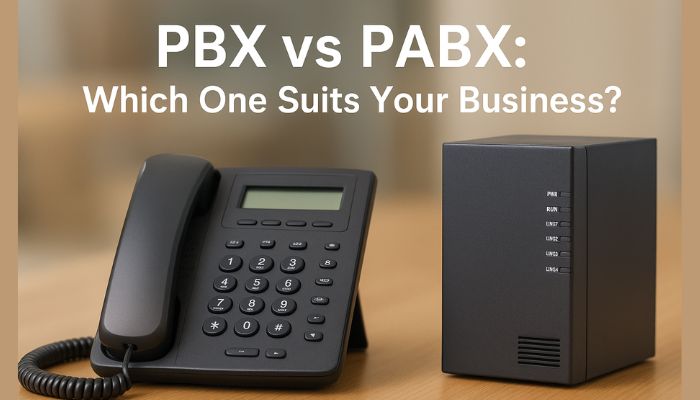
In the modern business world, communication systems play a critical role in productivity, customer experience, and scalability. Among the most commonly discussed solutions are PBX (Private Branch Exchange) and PABX (Private Automatic Branch Exchange). While they may sound similar, their capabilities and use cases differ significantly—especially in today’s digital-first environment.
This guide breaks down the key differences, benefits, and practical use cases of PABX vs. PBX to help you make an informed decision.
Understanding PBX
A PBX is a private telephone network used within an organization to manage incoming and outgoing calls. Traditional PBX systems rely on manual switching, often requiring an operator or receptionist to route calls.
Benefits of PBX
- Reliable internal communication
- Lower call costs within the organization
- Simple setup for small offices
- Works well in stable, on-site environments
Limitations
- Requires manual intervention
- Limited scalability
- Minimal advanced features
- Not ideal for remote or hybrid work setups
Understanding PABX
A PABX is an upgraded, automated version of PBX. It eliminates the need for human operators by using intelligent systems to route and manage calls efficiently.
Benefits of PABX
- Fully automated call handling
- Advanced features like IVR and call queuing
- Integration with CRM and business tools
- Supports VoIP and cloud-based communication
- Scalable for growing businesses
- Enables remote work and multi-location connectivity
Key Differences Between PABX and PBX
1. Automation
- PBX: Manual or semi-automatic
- PABX: Fully automated with minimal human involvement
2. Technology
- PBX: Analog or basic digital systems
- PABX: Digital, IP-based, and often cloud-hosted
3. Scalability
- PBX: Limited expansion capabilities
- PABX: Easily scalable as your business grows
4. Features
- PBX: Basic calling functions
- PABX: Advanced tools like IVR, voicemail-to-email, analytics
5. Cost Efficiency
- PBX: Lower upfront cost but higher maintenance
- PABX: Higher initial setup (in some cases) but better long-term ROI
Use Cases: Where Each System Fits
When to Use PBX
PBX systems are suitable for:
- Small businesses with basic communication needs
- Offices with minimal call traffic
- Organizations using legacy infrastructure
- Environments where automation is not a priority
When to Use PABX
PABX systems are ideal for:
- Growing businesses needing scalable solutions
- Call centers handling high call volumes
- Companies with remote or hybrid teams
- Businesses requiring CRM integration and analytics
- Enterprises focused on improving customer experience
Why PABX Is Dominating Today
With the rise of cloud computing, remote work, and AI-driven tools, PABX has become the preferred choice for modern organizations. It not only improves efficiency but also enhances customer satisfaction through faster and smarter call handling.
Many modern systems are now IP-PABX or cloud PABX, combining internet-based calling with powerful automation features—something traditional PBX simply cannot match.
Final Thoughts
The comparison between PABX vs. PBX ultimately comes down to simplicity vs. capability.
- PBX is a traditional solution suited for basic needs
- PABX is a modern, automated system designed for efficiency and growth
If your business aims to stay competitive in today’s fast-paced environment, investing in a PABX system is a smart move that supports both current operations and future expansion.