



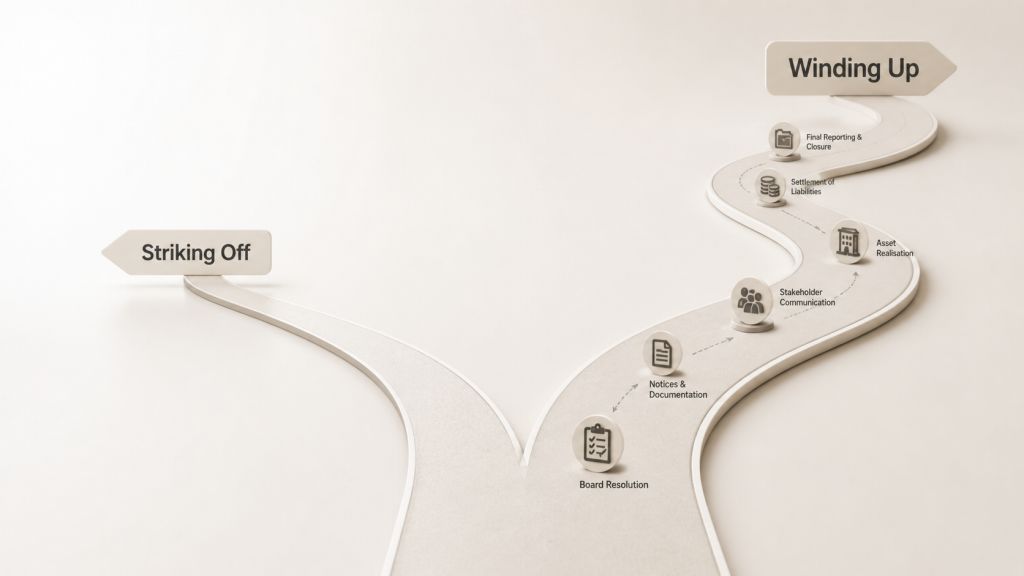
The business story concludes. Shifting demographics made your offering obsolete. The core team pursued separate paths. Or the funding runway proved insufficient for takeoff. Whatever narrative defines your ending, you have resolved to close your Singapore company. Now you face a defining choice: striking off or winding up?
Both achieve permanent corporate dissolution. Yet their procedural foundations stand in stark contrast. One functions as administrative efficiency. The other operates as legal thoroughness. An uninformed choice squanders money and extends timelines. Worse, it may preserve director liabilities that proper procedure would eliminate. This guide provides the clarity needed for confident navigation.
What Is Striking Off?
Striking off serves as the streamlined administrative dissolution pathway. ACRA removes the company from the official register without court involvement. This mechanism targets entities that have lapsed into dormancy or definitively ceased trading.
Qualification requirements are stringent and absolute. The company must hold no assets whatsoever. It must owe nothing to any creditor. No registered charges may encumber the entity. Legal proceedings must be entirely absent—neither active nor threatened. Contingent liabilities must be demonstrably resolved. Every director must consent without reservation. The company must show complete business cessation.
For qualifying entities, execution proceeds efficiently. Applications submit through ACRA's BizFile+ digital portal. Staff review statutory compliance. Upon acceptance, dissolution notice publishes in the Government Gazette. A statutory three-month observation period allows objections. Silence from all parties results in final, irrevocable dissolution.
The complete timeline spans approximately four to six months. Costs remain minimal, essentially the government processing fee. However, a material caveat endures. Striking off does not immunize directors against subsequently discovered claims. Creditors maintain restoration rights for considerable periods. This option applies solely to entities with absolute confidence that no obligations remain.
Preparatory diligence is critical. Directors must verify current compliance across all historical filings. This is where professional corporate secretarial services demonstrate distinctive value. Experienced practitioners conduct exhaustive compliance audits. They identify gaps in annual returns or board resolution documentation. They remediate these deficiencies before ACRA review, dramatically improving approval probability.
What Is Winding Up?
Winding up represents the comprehensive legal dissolution alternative, commonly called liquidation. A licensed liquidator assumes full operational authority. They identify, secure, and convert assets to cash. They adjudicate creditor claims and satisfy them in statutory priority order. They distribute residual value to shareholders. Dissolution follows only upon completion of this entire sequence.
Two fundamental categories exist. Voluntary winding up originates through director or shareholder resolution. Solvency classification determines the specific variant. Companies capable of discharging all debts within twelve months proceed via members' voluntary winding up. Those lacking such capacity enter creditors' voluntary winding up, incorporating mandatory creditor meetings and enhanced disclosure obligations.
Compulsory winding up operates through judicial order, typically following formal creditor petition. This constitutes the most procedurally elaborate and financially demanding route. It frequently signals severe financial distress. Directors surrender all control immediately upon court appointment.
Winding up becomes essential when asset realization is necessary, formal creditor resolution is required, or legal disputes demand adjudication. It furnishes robust legal closure with comprehensive protective finality. Upon completion, directors generally obtain broad immunity from prior operational claims. This safeguard proves critical for individuals planning future ventures.
The procedural density requires sustained administrative precision. Accurate record-keeping and timely regulatory interaction remain paramount. Competent company secretary services support directors in drafting compliant resolutions and statutory notices. They preserve register integrity throughout the liquidator's tenure. They facilitate seamless coordination between the liquidator, ACRA, IRAS, and additional stakeholders. Their involvement prevents administrative errors that could compound difficulties or attract regulatory intervention.
How to Decide
Correct selection depends entirely on context. Your company's specific circumstances dictate the appropriate mechanism. Systematically evaluate these diagnostic elements.
Does the company retain any asset holdings? Affirmative responses generally compel winding up. Assets require professional valuation, market exposure, and lawful distribution to entitled parties. Simple abandonment is not legally permissible. Are outstanding obligations present? Even seemingly minor unpaid amounts carry significant legal weight. Existing creditors necessitate winding up to ensure lawful claim treatment. Attempting striking off with unresolved debts exposes directors to meaningful personal liability risk.
Is the company demonstrably solvent? Twelve-month debt-paying capacity supports members' voluntary winding up. Insolvency triggers the creditors' process with its additional procedural layers and oversight requirements. Can all directors reach unanimous agreement? Striking off demands complete consensus from every director. Internal disagreement may render winding up the only practically available alternative.
Do pending tax or legal matters remain unresolved? Active IRAS investigations or ongoing litigation will automatically preclude striking off applications. These matters must reach resolution first. If responses are uniformly negative regarding assets, debts, and disputes—and director unanimity exists—striking off likely suits your situation. Any affirmative response indicates winding up as the more prudent course.
Engaging corporate secretarial services during this evaluative phase yields substantial analytical benefits. Professionals apply objective scrutiny to your financial position. They surface obligations or claims you may have overlooked. They quantify both pathways with realistic cost projections and timeline estimates. This analytical discipline prevents expensive strategic miscalculations.
The Role of Professional Support
Corporate dissolution extends considerably beyond completing administrative forms. Legal ramifications and financial exposures permeate every stage. Expert guidance is strategically indispensable rather than merely convenient.
Firms delivering corporate secretarial services expertly manage striking off applications with comprehensive thoroughness. They validate eligibility against every statutory criterion with rigor. They prepare and submit documentation with meticulous precision and completeness. They handle all ACRA correspondence and supplementary inquiries. They bring historical statutory records into flawless condition prior to submission. This diligence minimizes rejection probability and compresses processing timelines. Accomplished providers possess intimate understanding of ACRA's specific evaluation triggers. They architect applications to avoid activating regulatory scrutiny.
Winding up demands more elaborate professional orchestration. Licensed liquidators execute technical liquidation functions. However, your company secretary maintains integral operational continuity throughout. They sustain record accuracy during the extended proceedings. They assist with director resolutions, shareholder communications, and regulatory notifications. They coordinate between the liquidator and multiple regulatory authorities. Established company secretary services provide this continuity, ensuring no compliance element unravels during demanding circumstances.
Post-dissolution obligations also require professional management. Following striking off, residual tax correspondence or regulatory inquiries may arise. After winding up, official dissolution certificates must reach financial institutions, lessors, and commercial partners. Capable providers address every trailing requirement comprehensively. They transform procedural complexity into methodically managed execution.
The psychological dimension intersects importantly with practical demands. Company closure frequently coincides with significant personal stress or professional disappointment. During such periods, delegating to corporate secretarial services Singapore preserves director capacity for high-stakes strategic decisions. It ensures compliance standards remain impeccable even when internal attention is fragmented by competing pressures.
Common Pitfalls to Avoid
Certain predictable errors recur with troubling frequency among Singapore directors. Submitting striking off applications while residual corporate obligations persist represents the foremost mistake. An undiscovered bank account maintaining even minimal balances, or an overlooked trade creditor invoice, virtually guarantees application rejection. Complete organizational cleanup must precede any submission. Terminate all banking relationships. Satisfy every outstanding obligation. Surrender or cancel all applicable licenses and permits.
Tax clearance negligence constitutes another prevalent and costly oversight. IRAS must provide explicit written confirmation that zero tax matters remain outstanding. Submit all required final returns promptly. Secure formal clearance documentation. Never presume reliable coordination between ACRA and IRAS—in practice, such integration is inconsistent and unreliable. Directors bear exclusive and non-delegable responsibility for tax compliance verification.
Initiating winding up without comprehensive cost comprehension creates third-category difficulties. Liquidator professional fees, court filing charges, statutory advertising expenses, and ancillary disbursements accumulate substantially. Obtain detailed written quotations from multiple licensed liquidators before making commitment decisions. Define scope inclusions and exclusions with precision. Establish realistic completion parameters with explicit milestones.
Inadequate advance communication with stakeholders forms a final frequent trap. Credit-extending financial institutions, commercial property landlords, and material contract counterparties deserve proactive notification. Unexpected closures can activate default provisions, penalty clauses, or breach declarations. A formal advance notification letter, however concise, prevents substantial unnecessary downstream friction.
Some directors attempt to manage closure processes internally to reduce professional expenditures. This approach frequently proves economically counterproductive. A single missed regulatory deadline, improperly worded resolution, or incomplete filing can invalidate months of effort and necessitate restarting the entire procedure. Retaining company secretary services from project inception protects against these self-inflicted, expensive setbacks.
Final Thoughts
Concluding a company with proper form and integrity reflects mature, responsible leadership. Correct execution shields directors from future vulnerability and exposure. It respects legitimate creditor interests through procedural fairness and transparency. It produces definitive, legally secure closure that permits all parties to advance with confidence.
Striking off delivers commendable efficiency and cost containment, but applies exclusively to genuinely dormant entities completely free of obligations. Winding up offers exhaustive legal protection and finality, yet requires greater resource commitment and extended duration. No universal prescription exists. Appropriate selection emerges only from honest, thorough assessment of your company's actual factual condition.
When doubt or ambiguity persists, pursue professional consultation without hesitation. Qualified providers of corporate secretarial services can assess your eligibility with analytical objectivity. They can articulate both pathways with clarity, precision, and realistic expectations. They can prepare required documentation systematically and efficiently. This preliminary investment in understanding yields substantial returns through reduced stress, compressed timelines, and avoided costly errors.
Resist impulsive or hasty determination. Catalog all assets, liabilities, and outstanding commitments with comprehensive thoroughness. Engage in transparent, good-faith dialogue with fellow directors. Retain experienced professional advisors with demonstrated expertise in Singapore corporate law. Then commit to the pathway that genuinely and accurately reflects your operational reality. A meticulously executed, clean exit constitutes the ultimate and most enduring demonstration of sound corporate governance. Its significance resonates far beyond the company's legal termination date.